AI Agent Development Process: From Idea to Production

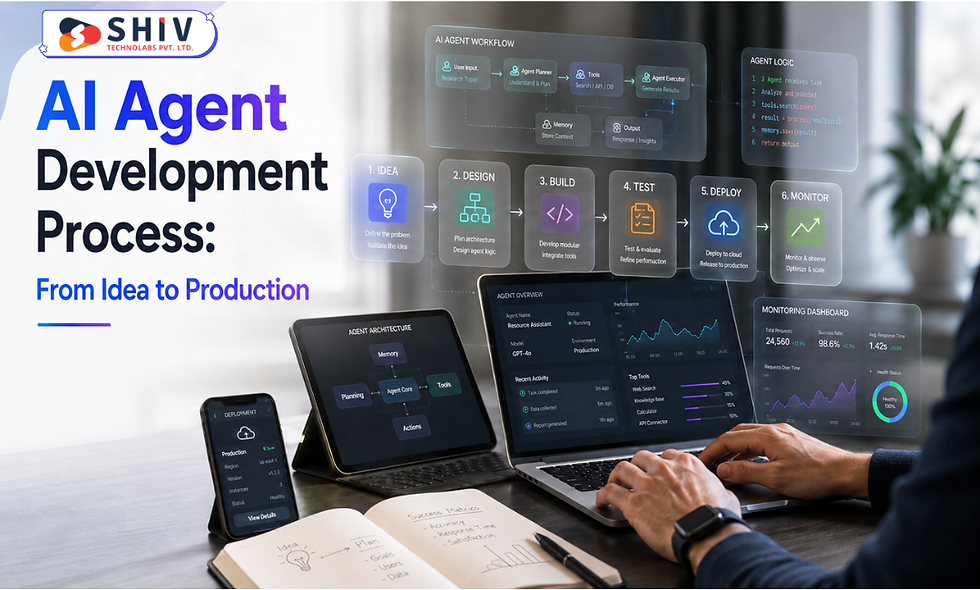
Many businesses begin their AI journey with a practical question: Can an AI agent reduce manual work, respond to customers faster, qualify leads, prepare reports, or support internal teams? Turning that idea into a working product takes more than writing a prompt. The agent must understand its role, access the right data, connect with business systems, and complete tasks within clear limits.
A production-ready solution also needs careful planning, suitable tools, structured testing, access controls, and regular performance checks. Professional AI agent development services help businesses manage each stage with a clear process. This guide explains how an AI agent moves from an initial idea to a reliable system used in real business operations.
What Is the AI Agent Development Lifecycle?
The AI agent development lifecycle is the step-by-step process used to turn an AI agent idea into a working business solution. It covers planning, architecture, development, testing, production release, performance tracking, and ongoing updates.
Each stage helps the team connect the agent with the right data, models, tools, business rules, and safety controls.
Idea: Identify the initial concept and the business problem the AI agent should solve.
Use Case: Select a specific task or workflow where the AI agent can provide practical value.
Architecture: Plan the models, data sources, tools, APIs, memory, and safety controls required for the agent.
Development: Build the AI agent, connect the required systems, and define its instructions and actions.
Testing: Check the agent’s accuracy, safety, reliability, tool usage, and response quality across different situations.
Production: Release the AI agent within a controlled business environment for real users and workflows.
Monitoring: Track performance, costs, errors, user feedback, and system activity to support regular improvements.
A well-planned lifecycle gives business and technical teams a clear view of project goals, responsibilities, risks, progress, and expected results.
Why the AI Agent Development Process Matters: 9 Essential Steps

AI agents can search databases, connect with APIs, update customer records, send messages, create tasks, and manage business workflows. These capabilities can reduce manual work and save time, but they need careful planning.
A clear AI agent development process helps teams set goals, define system limits, manage access permissions, test real situations, review performance, control costs, improve response accuracy, and add human approval for sensitive actions.
The following nine steps show how businesses can turn an AI agent idea into a reliable production system.
1. Define the Business Problem
Begin with one specific business problem. Choose a task that takes too long, creates repeated errors, or affects team productivity.
For example, a customer support team may spend hours answering similar questions. A sales team may manually check every new lead. An AI agent can support these tasks when the workflow has clear inputs, actions, and expected results.
2. Set Goals and Success Metrics
Set measurable goals before the development work begins. Clear metrics help the team understand whether the agent delivers useful business results.
Common metrics include:
Task completion rate
Response accuracy
Average handling time
Human handoff rate
Cost per task
User satisfaction
The first version should focus on one important workflow and complete it accurately.
3. Review Data and System Requirements
Identify the information the agent needs to complete its tasks. This may include product documents, support tickets, customer records, internal policies, order details, or database entries.
Check data accuracy, update frequency, access permissions, privacy requirements, and API limits. Trusted and current data helps the agent provide useful answers and take correct actions.
4. Design the Agent Architecture
Plan how each part of the system will work together. The architecture may include the language model, instructions, memory, knowledge sources, APIs, business tools, and human approval points.
A single agent may work well for a focused workflow. A larger process may need several agents with separate roles. Keep the structure manageable so the development team can test, monitor, and maintain it.
5. Choose an AI Agent Development Framework
An AI agent development framework gives developers a base for managing instructions, tools, memory, workflows, and model calls.
Compare framework options based on:
Model support
Tool-calling features
State and memory management
Testing and tracing
Hosting requirements
Security controls
Maintenance needs
The selected framework should match the project scope, technical skills, workload, and production requirements.
6. Select AI Agent Development Tools
AI agent development tools support model access, knowledge retrieval, API connections, prompt management, testing, logging, and access control.
Choose each tool based on a clear project need. It should help the agent complete a task, track an action, or reduce operational risk.
A smaller toolset often makes the system easier to manage during the early development stage.
7. Build the First Working Version
Create a focused version that handles one main workflow. Add clear instructions, data access, selected tools, action limits, and human approval rules.
Test the agent with real business examples. Include common requests, unclear questions, missing details, and unusual situations.
The first version helps the team identify gaps before releasing the agent to more users.
8. Test Quality, Safety, and Reliability
Test the complete action path instead of checking only the final response. Review the data the agent selected, the tools it called, the actions it completed, and the way it handled errors.
Create test cases for:
Normal user requests
Missing or incorrect data
Tool and API failures
Restricted actions
Harmful instructions
Sensitive customer tasks
Add human review for financial, legal, account-related, or customer-facing actions. Record failed cases and include them in future testing.
9. Plan AI Agent Deployment and Monitoring
Start AI agent deployment with a small user group or a limited business process. This approach gives the team practical feedback while keeping early risks under control.
Track task completion, response time, model costs, tool errors, escalation rates, and user feedback. Review system logs to understand how the agent reached each decision.
After the production release, update instructions, data sources, permissions, and test cases as business needs change.
AI Agent Development Cost and Timeline Overview
Pricing and timelines vary by complexity, but a general range helps with early budgeting:
Agent Complexity | Timeline | Estimated Cost |
Single agent, one workflow, 2-3 tools | 6 to 8 weeks | $15,000 to $30,000 |
Single agent, multiple integrations, human-in-loop | 8 to 12 weeks | $30,000 to $55,000 |
Multi-agent, complex orchestration, custom security | 14 to 20 weeks | $60,000 to $120,000+ |
Data readiness and integration complexity usually move a project between these bands more than the model choice does.
When Should You Hire an AI Agent Development Company?
A business may need an AI agent development company when the project involves private data, custom APIs, multi-step workflows, strict access rules, or ongoing production support.
An experienced team can connect business goals with architecture, development, testing, and maintenance.
Custom AI agent development makes sense when ready-made tools cannot match the company’s workflow, data, or security needs.
Build a Custom AI Agent With Shiv Technolabs
Shiv Technolabs provides AI agent development services for businesses that want to automate tasks and improve daily operations. Our team builds custom AI agents based on your workflows, data, software platforms, and business goals.
We support planning, architecture, tool integration, testing, production launch, and ongoing maintenance. Our developers create AI agents for customer support, sales, reporting, knowledge search, and workflow automation.
Contact us today to discuss your AI agent requirements.
Conclusion
The AI agent development process starts with a clear problem and continues through planning, development, testing, production release, and monitoring. Strong projects follow defined AI agent development steps, use trusted data, set measurable goals, test real situations, and control system access. A focused first version lowers risk and helps businesses move from an idea to a reliable production system.
Frequently Asked Questions
1. What is the AI agent development process?
It is the structured path from identifying a business problem to running an agent in production. It covers goal-setting, data review, architecture design, tool selection, building, testing, deployment, and ongoing monitoring.
2. What are the main stages of the AI agent development lifecycle?
The lifecycle moves from idea to use case, then architecture, development, testing, production, and monitoring. Each stage feeds the next, and monitoring data typically leads back into architecture and data updates.
3. How long does it take to develop an AI agent?
A single-agent workflow with limited tools usually takes 6 to 8 weeks from planning to a production-ready release. Multi-agent systems with complex integrations often take 14 to 20 weeks depending on data readiness and security requirements.
4. Which AI agent development framework should a business choose?
The right framework depends on the existing model provider, team skills, and hosting setup. Teams standardized on OpenAI often pick the Agents SDK, while complex multi-step workflows tend to favor LangGraph or CrewAI.
5. How much does custom AI agent development cost?
A focused single-agent project typically runs from $15,000 to $30,000, depending on integration complexity and data readiness. Multi-agent systems with custom security and evaluation needs often range from $60,000 to $120,000 or more.
6. How do you test and monitor an AI agent in production?
Testing covers normal requests, edge cases, tool failures, and misuse attempts before launch, reviewing the full action path rather than just the final answer. Monitoring after launch tracks task success, latency, cost, escalation rate, and unexpected actions on an ongoing basis.


Comments