AI Integration with Legacy Systems: Strategies, Challenges, and Solutions


Many businesses rely on legacy software to manage finance, customer records, inventory, production, and other critical operations. These systems may still support daily work, but they often struggle to meet modern demands for automation, real-time insights, and faster decision-making. Replacing the entire technology environment can require significant investment, create operational disruption, and take several years to complete.
AI integration with legacy systems offers a more practical approach by adding intelligent capabilities to existing applications. With the right AI development services, businesses can introduce predictive analytics, document processing, customer support automation, and smarter workflows while keeping their core systems active.
This guide explains how AI legacy system integration works, the challenges businesses may face, and the steps required to modernize legacy applications securely and efficiently.
What Is AI Integration with Legacy Systems?
AI integration with legacy systems means connecting artificial intelligence tools with older software, databases, or infrastructure. The goal is to improve current processes through automation, prediction, and intelligent decision support.
A company may connect an AI model to an old ERP, CRM, mainframe, or custom application. The model reads approved data and returns useful results to the original platform. This supports legacy systems AI integration without forcing a complete replacement.
Legacy system modernization may use APIs, middleware, data pipelines, robotic process automation, or microservices. The right method depends on architecture, data quality, security needs, and the business goal.
Related Article: 7 Signs Your Business Is Ready for an AI Agent and 3 Warning Signs
Why Businesses Add AI to Legacy Systems
AI helps businesses gain more value from existing applications. By connecting AI to these systems, businesses can uncover valuable patterns in historical data that traditional tools may overlook.
Modernizing legacy systems with AI can help companies predict demand, detect unusual activity, reduce manual work, and improve customer service.
AI-powered legacy modernization supports gradual improvement. A company can upgrade one process, measure the result, and expand after proving value.
Key Legacy System Integration Challenges and Solutions
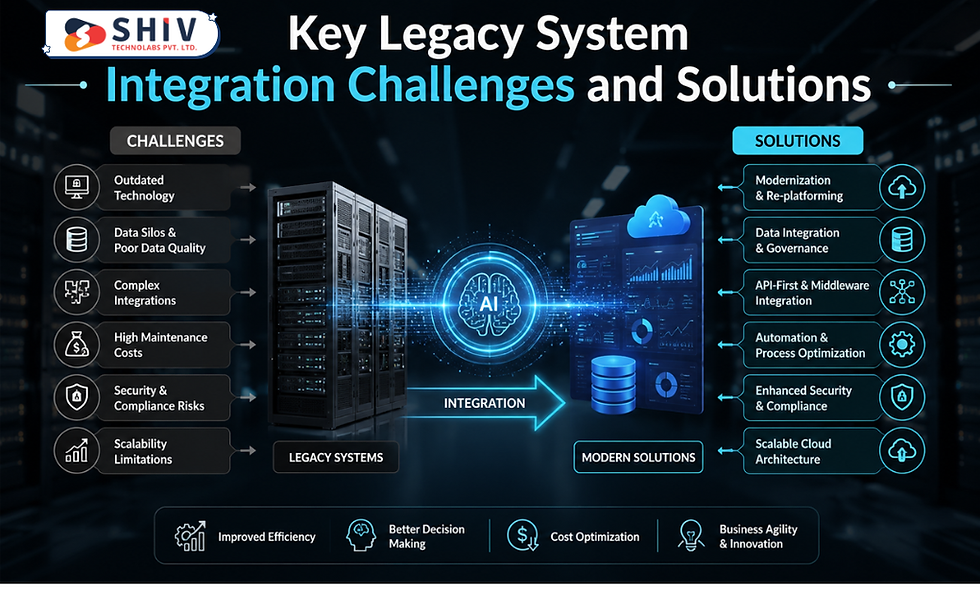
A successful project begins with a clear technical assessment. Common challenges involve data quality, architecture limits, security risks, and skill gaps.
Data Silos and Inconsistent Formats
Older systems often store information in separate databases. Departments may use different formats and naming rules. These data silos in legacy systems can reduce AI accuracy.
Teams should clean, standardize, and validate data. They should also define data ownership and update frequency.
Limited APIs and Connectivity
Older applications may not include modern APIs. Some systems only support batch files, database access, or manual exports.
Middleware or an API wrapper can create a secure connection. RPA can help when direct integration is unavailable.
AI Data Integration Challenges
AI models need reliable and relevant data. Missing fields, duplicate records, outdated information, and poor labels can affect performance.
A structured pipeline can collect, transform, validate, and deliver data to the model. Monitoring should detect failures or unexpected changes.
Legacy System Security Risks
Legacy applications may use outdated authentication methods or unsupported components. New integrations can create extra access points without careful planning.
Businesses should use encryption, role-based access, network controls, audit logs, and regular testing. AI should access only the required data.
Skills and Change Management
Legacy application modernization requires knowledge of old and new technologies. Teams may understand the legacy platform but lack experience with AI or modern integration tools.
Training, documentation, and clear ownership can reduce this gap. Users should also understand when human review remains necessary.
How to Integrate AI with Legacy Systems
A phased process helps businesses control cost, reduce risk, and measure results. These steps can guide an AI integration services project.
1. Audit the Existing Environment
Document applications, databases, interfaces, workflows, dependencies, and security controls. Identify critical systems and the limitations that create the most friction. This audit gives the team a realistic view of integration complexity.
2. Choose a High-Value Use Case
Select one business problem with a clear outcome. Good starting points include invoice processing, demand forecasting, predictive maintenance, fraud detection, or customer support. Define success through time saved, fewer errors, faster responses, or lower costs.
3. Prepare the Data
Review the required data. Remove duplicates, correct errors, standardize formats, and define access rules. Strong preparation reduces AI data integration challenges and gives the model a reliable foundation.
4. Select the Integration Method
Choose an approach that fits the system. APIs support secure connections, while middleware can connect several platforms and manage data exchange. Data pipelines support analytics. RPA helps with limited systems, while microservices add AI functions as separate components.
5. Build a Proof of Concept
Create a small solution for one process, department, or data set. A controlled proof of concept helps test technical feasibility and business value. Collect feedback and measure the agreed KPIs before a wider rollout.
6. Apply Security and Governance
Define who can access the AI system and what data it can use. Add encryption, monitoring, approval steps, and audit logs. Create rules for model updates, human review, error handling, and data retention.
7. Test the Complete Workflow
Test the AI model, data transfers, application performance, security controls, and failure recovery. Include unusual cases and poor-quality inputs. Complete testing shows how the system behaves under real conditions.
8. Deploy and Scale Gradually
Launch the solution with a limited user group or process. Monitor model accuracy, system speed, business results, and feedback. Expand after the solution proves stable, secure, and useful.
What Does AI Legacy System Integration Cost in 2026?
Pricing depends on system complexity, data quality, and how many platforms need to connect. Based on current agency and enterprise benchmarks:
Project Type | Cost Range | Timeline |
Single-system integration (one legacy platform, one AI service) | $18,000 to $35,000 | 6 to 10 weeks |
Multi-system integration (2 to 4 platforms) | $35,000 to $65,000 | 10 to 16 weeks |
Enterprise-scale integration suite with middleware | $65,000 to $120,000+ | 16 to 24 weeks |
Ongoing maintenance and monitoring | $300 to $800/month | Continuous |
Mid-market companies pursuing partial modernization typically invest $150,000 to $500,000 in 2026, while full modernization of complex environments can exceed $2 million. AI-assisted code analysis and automated testing have compressed timelines that once took 18 months down to 5 to 7 months in many documented cases.
Should You Integrate, Modernize, or Replace Your Legacy System?
AI integration works well when the core system remains stable. It offers a faster path to automation and analytics with less disruption.
Partial modernization makes sense when specific modules create performance, security, or scalability issues. The business can replace those parts while keeping the rest active.
Full replacement may be necessary when the platform creates major risks or high maintenance costs. A detailed assessment can guide the decision.
Modernize Legacy Systems with Shiv Technolabs
Shiv Technolabs helps businesses integrate AI into existing applications through a secure and phased approach. Our team can help assess your legacy systems, identify suitable AI use cases, prepare data, design the right architecture, and manage integration, testing, and deployment.
Our AI development services include predictive analytics, intelligent automation, natural language processing, document processing, and custom machine learning solutions.
Contact us today to discuss your requirements and build a practical AI modernization roadmap.
Conclusion
AI integration with legacy systems allows businesses to introduce modern intelligence without replacing every existing application. A clear use case, reliable data, secure architecture, and phased rollout can turn older technology into a stronger business asset.
Organizations should begin with one measurable problem and expand after proving value. With the right AI development company and strategy, legacy systems can support automation, better decisions, and future innovation.
Frequently Asked Questions
1. What is AI integration with legacy systems?
It connects AI tools with older software, databases, or infrastructure. The AI layer adds automation, prediction, analysis, or intelligent support while the existing system manages core operations.
2. Can AI work with legacy systems without replacing them?
Yes. Businesses can use APIs, middleware, data pipelines, RPA, or microservices. The best method depends on architecture, data access, security, and the use case.
3. How do you integrate AI with a legacy system?
Start with a system audit and one high-value use case. Prepare the data, choose an integration method, build a proof of concept, apply security controls, test, and scale gradually.
4. What are the main challenges of legacy systems AI integration?
Common challenges include data silos, inconsistent formats, limited APIs, outdated infrastructure, security risks, and skill gaps. Early assessment and governance can help teams manage them.
5. What is the safest way to start AI legacy system integration?
Begin with a limited pilot using approved data. Add access controls, encryption, monitoring, human review, and clear success metrics before expanding.


Comments