Flutter vs React Native in 2026: Which Is Better for Your Business App?


When planning a mobile app, selecting a suitable framework plays a major role in the success of a business app. Flutter and React Native often come up as the top options because both allow development for Android and iOS from a single codebase. This helps save time, reduce cost, and simplify the development process.
Many businesses now prefer Flutter app development services to build scalable and high-performance applications with a consistent design across platforms. However, these frameworks follow different approaches and offer different advantages. This guide breaks down Flutter and React Native in a clear and practical way, so you can decide which one is the right fit for your business app in 2026.
What Is Flutter and How Does It Work in Business Apps

Flutter is an open-source framework developed by Google that allows developers to build apps for Android, iOS, web, and desktop using a single codebase. It uses Dart and a widget-based system to create user interfaces with full design control.
This approach helps businesses maintain consistent design across platforms and reduces development time. Teams can manage updates easily without building separate apps for each platform.
Flutter also supports fast development and flexible UI design, which helps businesses build scalable applications efficiently.
Key Features and Benefits of Flutter
Single codebase supports multiple platforms
Hot reload allows instant updates during development
Custom widgets enable flexible UI design
High performance with smooth user experience
Easy maintenance with centralized updates
What Is React Native and How Does It Work in Business Apps
React Native is a framework based on JavaScript and React that helps developers build mobile applications using native components. It allows apps to follow platform-specific design, which helps deliver a smooth user experience on Android and iOS devices while using a shared codebase.
Many businesses choose React Native when they already have a React team. This reduces learning time and helps developers build apps faster. It also improves efficiency by allowing reuse of existing knowledge and tools.
Key Features and Benefits of React Native
Uses JavaScript, which is widely known among developers
Supports code reuse for faster mobile app development
Native components provide a platform-specific user experience
Large ecosystem of libraries and tools for quick feature integration
Faster development for teams with React experience
Flutter vs React Native: Key Feature Comparison
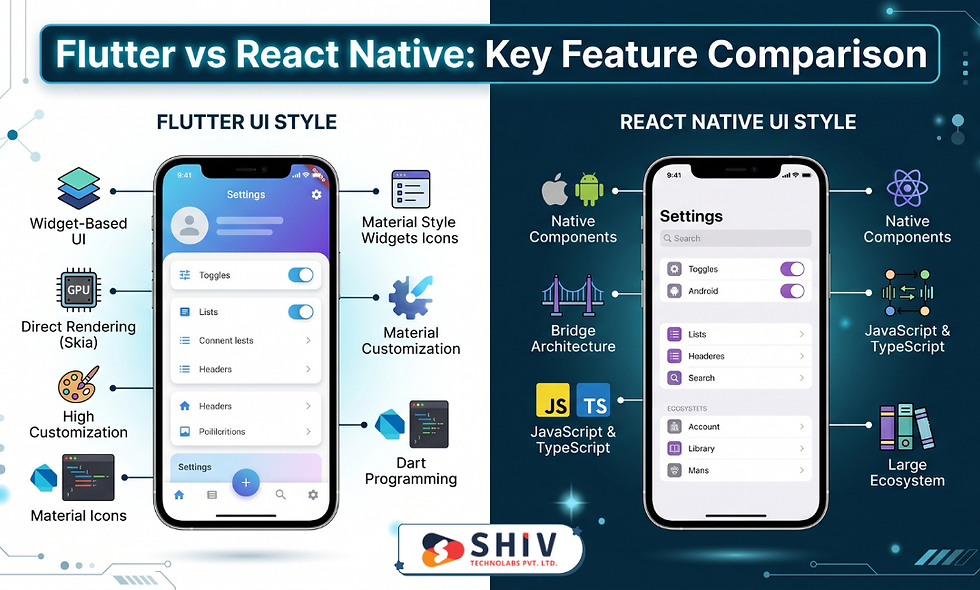
Feature | Flutter | React Native |
Programming Language | Flutter uses Dart, which is designed for building fast apps with a structured approach. | React Native uses JavaScript, which is widely used. Developers with React experience can start quickly without much learning effort. |
UI Rendering | Flutter uses its own rendering engine, which helps maintain the same design across all platforms. | React Native uses native components, which match platform-specific design. |
Performance | Flutter delivers strong performance because it compiles directly into native code. | React Native offers good performance for most apps. |
Development Speed | Flutter supports fast development with features like hot reload. | React Native also supports fast development, especially for teams already familiar with React and JavaScript. |
Code Reusability | Flutter allows high code reuse across mobile, web, and desktop. | React Native supports code reuse mainly for mobile apps. |
Flutter vs React Native Key Differences for Business Apps
Flutter and React Native follow different approaches when it comes to building user interfaces and handling development. Flutter uses its own rendering engine to control every part of the UI. This allows developers to create a consistent design across all platforms, which is helpful for businesses that want strong branding and a uniform user experience.
React Native, on the other hand, uses native components provided by each platform. This helps apps feel more natural on Android and iOS devices. However, the design may vary slightly because each platform has its own UI behavior.
The development approach also differs between the two frameworks. Flutter uses a structured, widget-based system that makes it easier to manage layouts and maintain design consistency. Developers can build complex interfaces in a more organized way.
Flutter vs React Native: Features and Advantages for Business Apps
Key Features and Advantages of Flutter
Single codebase supports Android, iOS, web, and desktop platforms
A widget-based system provides full control over UI design
Helps maintain consistent design across all devices
Hot reload allows instant updates during development
Delivers high performance with near-native speed
Supports custom UI for modern and interactive applications
Reduces development time and improves productivity
Key Features and Advantages of React Native
Uses JavaScript and React, which are widely known technologies
Allows faster development for teams with React experience
Uses native components for platform-specific design
Supports code reuse to reduce development effort
Large ecosystem of libraries and third-party tools
Helps build mobile-first applications efficiently
Choosing Between Flutter vs React Native for Your Business App
Choosing between Flutter and React Native depends on your business goals, team skills, and app requirements. Both frameworks support cross-platform development, but they differ in performance, UI control, and development approach. Understanding these differences helps you choose the right technology for your project.
Businesses that need consistent design and support across multiple platforms often prefer Flutter. Teams with experience in JavaScript and React may find React Native easier to adopt. The final decision depends on factors like speed, budget, scalability, and technical expertise.
When to Use Flutter
When you need a consistent UI across Android, iOS, web, and desktop
When your app requires custom design and smooth animations
When you want a single codebase for long-term scalability
When performance and UI control are top priorities
When Not to Use Flutter
When your team is not familiar with Dart and needs faster onboarding
When the project depends heavily on platform-specific native features
When you only need a simple mobile app with standard UI
When to Use React Native
When your team already works with JavaScript and React
When you want faster development for mobile-first apps
When your app uses standard features and native UI patterns
When you want to reuse existing React knowledge
When Not to Use React Native
When your app requires highly customized UI or animations
When performance is critical for complex applications
When managing multiple native modules becomes difficult
Why Choose Shiv Technolabs as Your Flutter App Development Company
Shiv Technolabs is a trusted choice for businesses looking to build high-quality Flutter applications. Our team focuses on delivering apps with strong performance, clean design, and a smooth user experience across platforms. We understand business requirements and work closely with clients to build solutions that match specific goals.
From initial planning and UI design to development, testing, and ongoing support, Shiv Technolabs handles the complete app development process. We help businesses launch their apps faster while maintaining quality and reliability. If you are planning to build a cross-platform app, you can contact us to discuss your project and get expert guidance tailored to your needs.
Conclusion
Flutter and React Native both offer strong solutions for building business apps in 2026, but the right choice depends on your specific requirements and long-term goals. Flutter works well for apps that need consistent design, high performance, and support across multiple platforms from a single codebase.
React Native is a practical option for teams with JavaScript experience who want faster development for mobile-focused projects. By understanding your app needs, team expertise, and future scalability, you can select a framework that supports efficient development and delivers a reliable user experience.
FAQ
Is Flutter a better choice than React Native for long-term app maintenance?
Flutter makes long-term maintenance easier because it uses a single codebase for multiple platforms. Updates, bug fixes, and feature additions can be managed in one place. React
Native may require extra effort when dealing with native modules and third-party dependencies. For businesses planning long-term scalability, Flutter often provides better control.
Can Flutter handle complex business apps like fintech or eCommerce platforms?
Flutter works well for complex applications that require custom UI, dashboards, and real-time features. It supports smooth performance and flexible design, which is important for industries like fintech and eCommerce. Many businesses use Flutter to build scalable apps that handle large user bases and advanced functionality.
Does React Native limit app performance compared to Flutter?
React Native delivers good performance for most standard apps, but performance may depend on how native modules are used. For apps with heavy animations or complex UI, Flutter often provides smoother performance. Businesses should evaluate their app requirements before choosing the framework.
Which framework is better for launching an MVP quickly, Flutter or React Native?
React Native is often a faster choice for MVP development when a team already has React experience. It allows quick setup and faster development in the early stages. Flutter can also build MVPs quickly, especially when the app requires a custom design and long-term scalability.


Comments